
From the futuristic gleam of the Year 3000 (Y3K) aesthetic to the rise of pet pampering and the allure of artificial intelligence (AI) love, 2024 presented a medley of new (life)styles reflecting the changes occurring in China’s ever-evolving social landscape.
Let’s dive into the subtle undercurrents, striking visuals and unexpected twists that reshaped the Middle Kingdom’s urban and fashion sceneries last year.
They reveal far more about the nation’s evolving cultural psyche than meets the eye.
Related
Happy 75th! Coupons to Couture: Fashion As a Lens on the Evolution of the PRC – The China Temper
Slow Burn to Bonfire
The year 2024 kicked off with a slow burn of nostalgia, with the drama series Blossoms Shanghai leading the way. Set in the 1990s and directed by the legendary Wong Kar-wai, the series took viewers inside the transformation of a sleepy city into a glittering metropolis.
But the show, which first hit screens on December 27, 2023, became about more than the city–it also captured the style of an era. On China’s lifestyle and e-commerce platform Xiaohongshu, users could be seen exchanging pointers on emulating the outfits of the show’s characters last January, according to Jing Daily, a news portal for the global business of luxury in China.
But why the nostalgia for the 90s?
Former Managing Editor of Jing Daily Julienna Law told this author at the time, “Even for those too young to have really lived it, the 90s [in Shanghai] was an era of charm, of hope for personal and economic advancement–hope that has since waned in light of rising living costs and employment challenges.”
But fashion is always reactive, often serving as a counterpoint to prior vogues and broader societal moods. In China, where social media fuels (life)style crazes 24/7, it’s no surprise that just two months into 2024, a new, blossoming mood board emerged: the Y3K aesthetic, a bonfire of glimmering colors and digital motifs that embodied a dramatic pivot toward optimism.
It was as if young Chinese hit Ctrl+Alt+Del on the past and rebooted with an entirely new attitude.
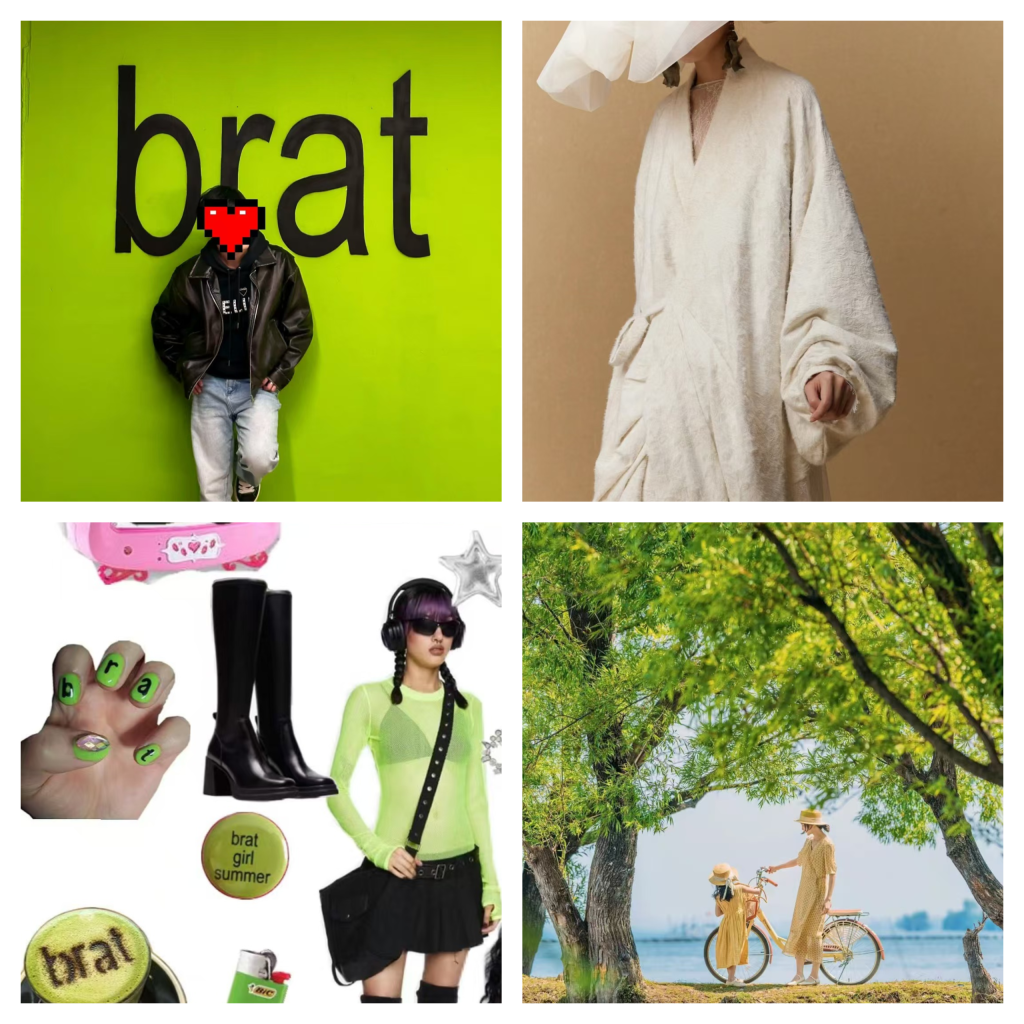
Top left: A man poses in front of a bright lime screen depicting the word “brat.” In honor of the Brat Green aesthetic, China’s socials this summer were flooded with pictures of young urbanites, from Beijing to Shanghai to Chengdu, hamming it up for the camera in front of green screens–and sometimes even subway walls. Pictures below show green moodboards as seen on Xiaohongshu, a Chinese lifestyle bible and e-commerce app. Top right: Chinese fashion label YuYun’s Fall/Winter 2025 collection, hailed by netizens as an example of “healing fashion”—which often features light color palettes and natural materials, as featured on the brand’s official Xiaohongshu account.
Color Me Bold
In the fast lanes of Chinese social media, color isn’t just a decorative afterthought–it’s a full-blown declaration. Following the rise of Y3K, three bold hues went on to capture the cultural zeitgeist: Mint Mambo, Brat Green and French Violet, each telling a deeper story about the society that selected them.
Last March, we saw Mint Mambo, an easygoing style that was a feisty blend of mint’s calming coolness, speaking to the rise of mental health consciousness among young Chinese, and the lively energy of mambo—yes, the Latin dance where your hips don’t lie, which resonated with the Gen-Z connection to global trends like TikTok challenges or viral dances, where youthful energy and self-expression are central themes. It stated: “I’m Zen, but ready to shake things up.”
Then came Brat Green, an acid lime hue that screamed, “I’m here. I’m messy. Deal with it.” Inspired by British singer and songwriter Charli XCX’s Brat album, released in June 2024, it became the anti-trend of the summer, symbolizing rebellious youth rejecting the highly filtered influencer culture.
Brat Green was the 2024 sequel to 2023’s Dopamine Dressing summertime fad, where wearing bright, cheerful outfits was said to boost your mood—and who couldn’t use a little more dopamine?
Jing Daily’s Meta Editor and Fashion Writer Bethanie Ryder elaborated on the flashy feel of both neon spectacles: “I love the fact that China’s Gen Z are turning to fashion as a medium of joy. I know the concept of Dopamine Dressing has been around for a couple of years now, but I think we’re in dire need of some color in our lives at the moment–and dopamine dressing offers exactly that.”
Amid these loud bursts of color, came the understated charm of French Violet. A muted, romantic blend of lavender and violet, the shade debuted just in time for the 2024 Paris Olympic Games in France, from July 26 to August 11, 2024, channeling the quiet power of French style–a power that’s more subtle than in-your-face.
All this flamboyant joie de vivre went on to reach a whole new, rather unconventional audience…
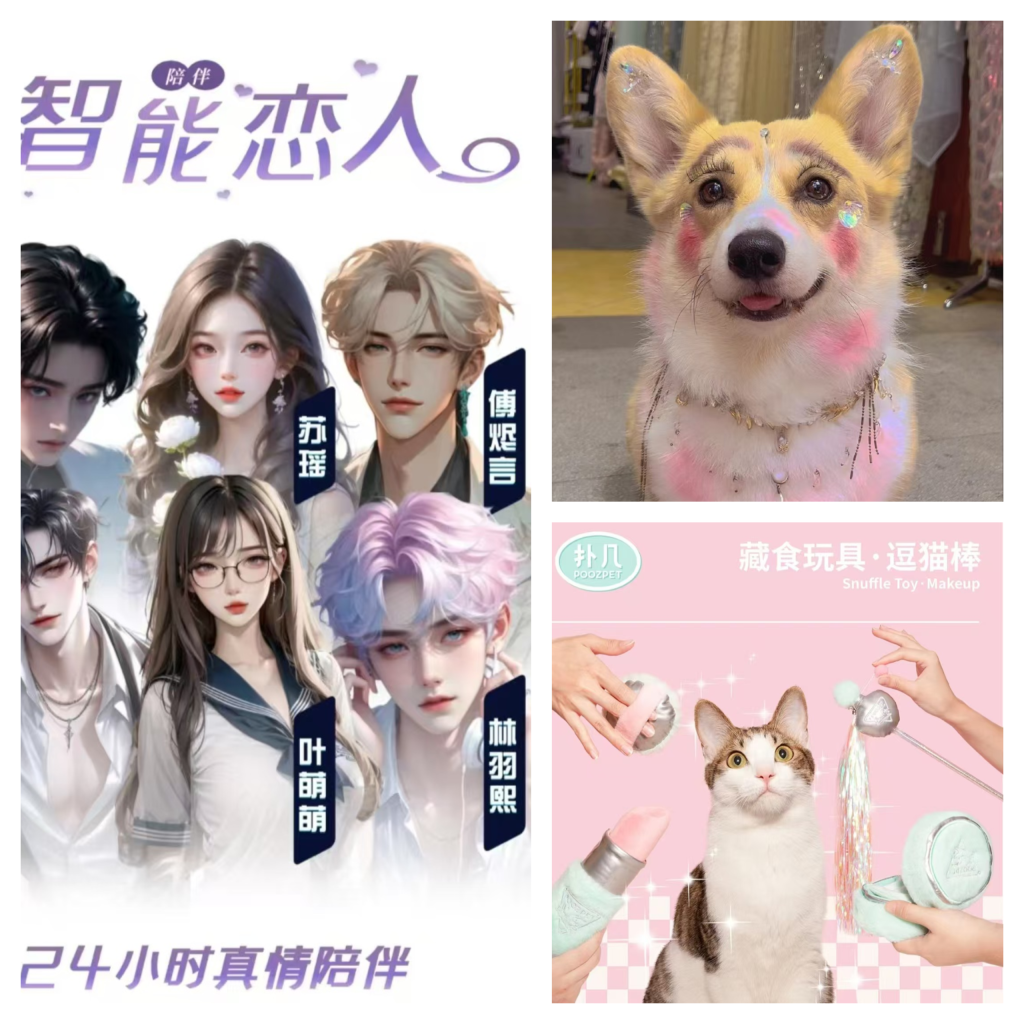
Left: An ad on Xiaohongshu for an app that promises AI-generated companionship–because why not let tech play cupid? Right: (top) A glammed-up corgi, posted by “chenpibushichenpi” on Xiaohongshu, a mega popular Chinese lifestyle and e-commerce platform, steals netizen hearts. (below) An ad for pet brand PoozPet on hte label’s official Xiaohongshu account.
Leashes To Lashes
As color exploded across fashion last year, the trend took an unexpected turn—into the realm of pets.
From tiny dogs in custom sweaters to cats in color-coordinated collars, young Chinese pet owners have gone all in, splurging on grooming, tailored outfits, and even pet-safe makeup. Yes, a dab of pink or violet blush here, a fake eyelash there, all curated to match their distinctive looks.
After all, fashion is about that purrfect fit. On Xiaohongshu, vloggers and their fur babies wearing matching outfits became a major hit this year. The hashtag “pet makeup products” alone raked in over 100k posts.
But behind the razzle-dazzle vogue lies a deeper story—that of China’s booming pet economy, driven by millennials and Gen Zs, both born during China’s one-child policy (1980-2016), who are reimagining family life through their fluffy friends.
In recent years, more young Chinese are living alone. According to the Ministry of Civil Affairs, an estimated 92 million were single-person households as of late 2021, up from 77 million in 2018. Many are finding emotional fulfillment in their fur babies. According to Statista.com, China’s urban pet population has grown nearly 50 percent over the past five years, with pet owners now spending over $900 a year on their furry companions. It’s a tale of paws and profits.
But then there are also those singles seeking companionship beyond the physical realm…
Love Is In The AIr?
Chinese Gen Z is swiping right on a new kind of love—AI-generated partners, according to a Beijing Evening News article from November. Whether a trend, cultural shift or existential experiment, one thing’s clear: these digital companions are rewriting the rules of romance, offering sweet texts and deep chats minus the emotional baggage of real-world relationships.
But what’s beneath the surface?
In a culture where the pressure to marry and settle down is high, AI partners offer a low-stakes alternative to the high-stakes drama of traditional relationships–no nagging in-laws, no ticking biological clock, just “intimacy” on demand. It’s the perfect budget-friendly antidote to the dating pressure cooker of the Middle Kingdom.
Of course, not everyone’s sold. Critics argue that AI companionship could deepen social isolation, making real-life connections closeness even rarer in this hyper-connected world. Perhaps this is a glimpse into a future where romance is less about “I do” and more about “I download.”
The question remains: Is leaning on AI for love good for you? Time will tell.
Maybe the real answer is still out there–at a café or under the open sky, where love and life wait for those bold enough to chase them. For those ready to step outside and search for real-world relationships, the world of trends offers plenty to explore.
Related
Pet Fashion: Young Chinese And Their Pursuit Of The Purrfect Fit – The China Temper
The Green Theme
One trend that’s been growing in popularity, according to Jin Xiaohang, a partner at Beijing Xiao & Xiao Information Consulting Co. Ltd., is the concept of liaoyu (meaning “healing” or “therapy”). Jin ranked it among his top three favorite trends on Xiaohongshu last year. Hashtags like “healing office space design” and “healing fashion” have racked up tens of thousands of posts, comments and likes, demonstrating a public desire for spaces and experiences that deliver not just style, but emotional comfort and some seriously chill vibes.
But it’s not just about fashion or décor. Hannah Dong, a designer at the same firm, has been noticing the fast-paced rhythm of life in Beijing ever since her return to the city from Boston, the United States, in April 2024. “Everything just moves at such a high speed here,” she remarked. “People are so driven by work that they barely have time to breathe, let alone think.”
And just when it seemed like the city couldn’t go any faster, a new trend emerged: 20 minutes in the park. “People started embracing nature like never before—hugging trees, taking in the fresh air and spending time in the park every day to recharge,” Jin explained. The “20 minutes in the park” trend, especially popular this autumn, was proof that even in a city like Beijing, nature could be the ultimate solution to urban burnout.
From calming green spaces to Mint Mambo vibes, the “green” theme has woven its way into the fabric of a society desperately seeking balance amid the breakneck pace of city life.
The great outdoors have become the ultimate stage for the “healing” lifestyle transformation–whether it’s a 20-minute walk to replenish your Zen or diving into heart-pumping social activities.
“More students are hiking or playing Frisbee [a trend that first emerged in 2022],” Lawrence Niu, a student at Beijing’s Tsinghua University, told yours truly. “These activities are affordable and offer a chance to escape the study grind and make new friends.”
The rise in popularity of outdoor sports mirrors a deep, collective yearning to reclaim control over health and wellbeing that first emerged during the COVID-19 pandemic. More people are lacing up their sneakers, hopping on bikes and heading out, a sporty phenomenon further fueled by the performances of Chinese Gen-Z Olympians in Paris.
But the true transformation isn’t just in the flips and tricks these athletes performed with BMX bikes, skateboards, breakdance moves, or world-record-shattering swims and dives on the world’s biggest athletic stage.
It’s in how the pursuit of holistic health has surged from a quiet undercurrent to a powerful mainstream wave—one set to sweep through 2025.
This is an edited version of Elsbeth van Paridon’s article first published in Beijing Review (Vol.67, Issue 52)
Featured image: Collage
SPOTTED A FASHION FAIL OR HAVE SOMETHING TO ADD? PLEASE LET US KNOW IN THE COMMENT SECTION BELOW OR EMAIL US AT INFO@CHINATEMPER.COM
© THE CHINA TEMPER, 2025. ALL RIGHTS RESERVED.
DO NOT REPRODUCE TEMPER CONTENT WITHOUT CONSENT -– YOU CAN CONTACT US AT INFO@CHINATEMPER.COM

Perpetually in pursuit of the greater good that is “China Fashion”, van Paridon set up The China Temper to help promote the dynamite dynamic fashion scene sprouting within Beijing, Shanghai, and China overall. Catering to anybody and everybody who reads English and/or Chinese, Temper covers all the basics and bases. From China's street style scenery to its budding photographers, internationally renowned designers, and underground quirks plus phenomena: We present one hot-hip-happening current collective weaving The New "Made in China" tag.
The term “Made in China” is undergoing the ultimate 21st Century makeover. Escorted by the increasingly strong influence of a new thinking among China’s younger generations, regarding individuality and the expression thereof, the fashion scene in the Middle Kingdom is exploding. And stretches far beyond what meets the eye. It’s appliqué, one might say.